Are Bestselling Authors Using Facebook Ads? We Checked 78 Author Brands
A snapshot of two Kindle bestseller lists found 30 active Meta advertisers and a revealing split in visible Amazon Attribution use. Here's what authors can learn.
There's plenty of advice about running Facebook ads for books. I wanted to look at what bestselling authors were actually doing.
Were they running ads? Were those ads sending readers to Amazon? And were they using Amazon Attribution to measure what happened after the click?
On November 19, 2026, we checked the top 50 paid Kindle books in Cozy Mystery and Romantic Suspense. Those 100 positions contained 78 distinct author names or brands after deduplication.
We found active Meta ads on pages matched to 30 of those 78 author brands, or 38.5%. Among the 28 advertisers with Amazon-bound paths in the ads we inspected, 13 had visible Amazon Attribution tags and 15 had no standard tag observed.
That's a useful starting point. Facebook and Instagram ads were clearly part of the marketing mix for a substantial share of this sample. The way advertisers measured that traffic was much less consistent.
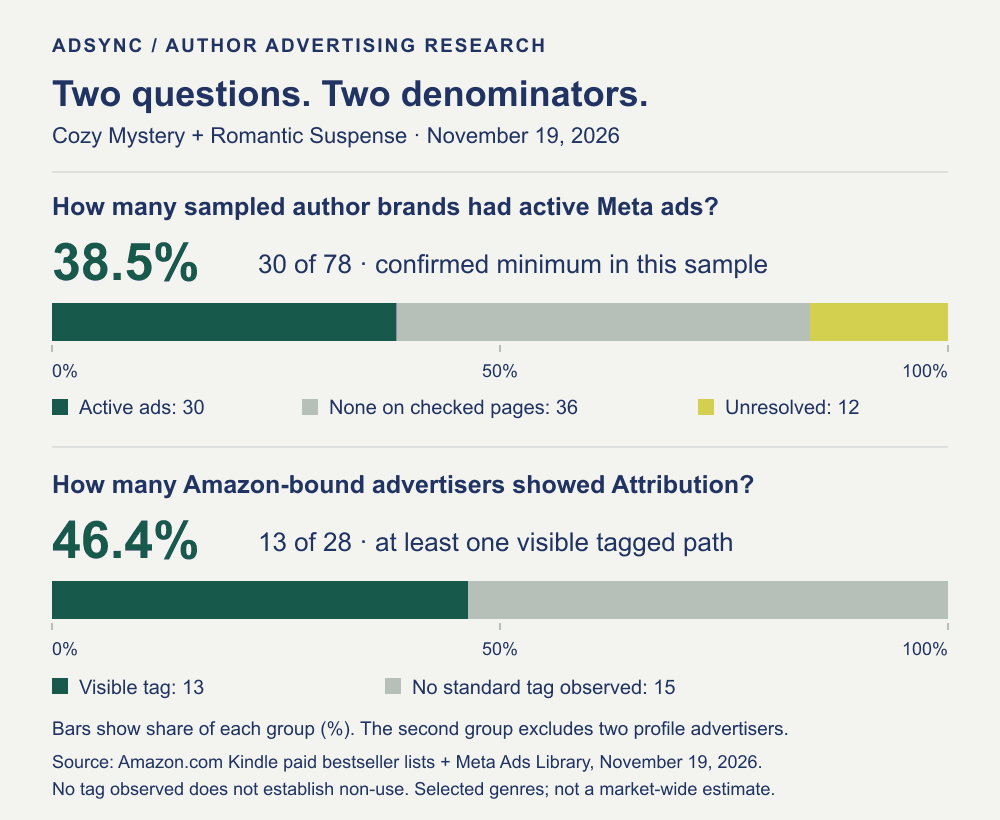
More than a third of the sample had active Meta ads
Here's the full breakdown:
- 30 author brands had active ads on matched pages.
- 36 had no active ads on the pages we checked.
- 12 remained unresolved because we couldn't confidently match an advertiser page to the author.
That makes 38.5% a confirmed minimum for this sample. It doesn't mean the remaining 61.5% never advertise. An author might use another page, have a publisher running campaigns, or simply have no ads live on the day we checked.
These were Meta ads, which can run on Facebook and Instagram. We weren't checking Amazon Sponsored Ads.
The finding is interesting because it puts something concrete behind the usual advice to try Facebook advertising. We could see active campaigns associated with authors appearing on these bestseller lists. It doesn't establish that the ads made their books bestsellers, or that those campaigns were profitable. Public ads don't tell us that.
Almost half of the Amazon-bound advertisers showed Attribution tags
Of the 30 advertisers we found, two promoted Instagram profiles in the ads we inspected. That left 28 with Amazon-bound paths:
- 13 of 28 (46.4%) had at least one visible Amazon Attribution-tagged path.
- 15 of 28 (53.6%) had no standard Attribution tag observed in the inspected paths.
For readers who haven't used it, Amazon Attribution measures Amazon shopping activity associated with tagged traffic from outside Amazon. You put the tracking link in your ad, then use Amazon's reports to see attributed results.
We could see those tags in ads from authors including Benedict Brown, Max Monroe, and Natalie Kane.
The important word in the other group is observed. We inspected public links, not private reporting accounts. A short link can hide tracking, redirects can change, and an advertiser may use another measurement system. Some links had affiliate tags or publisher tracking codes without visible standard Amazon Attribution markers.
So I wouldn't turn this into “half of bestselling authors don't track their ads.” The evidence supports a narrower observation: we found a sizable group of active advertisers whose inspected Amazon paths didn't visibly use standard Attribution tags.
For an author paying to send readers to Amazon, that's a good reason to check their own setup.
Some authors used tagged and untagged links at the same time
The split wasn't as simple as “authors who use Attribution” and “authors who don't.”
We found examples of both tagged and untagged destinations for the same author, including Naomi Kuttner, Steve Higgs, Fiona Tarr, Max Monroe, and Kira Cole.
My guess is that some of this is the ordinary mess of running ads over time. A campaign that works gets left alone. A newer campaign gets the newer tracking setup. A US ad gets a tag while an older UK version keeps its original link. An author and a publisher might also be working on separate campaigns.
Or it could be deliberate: testing a destination, promoting a free book, or serving a different goal. These are possible explanations, not things we verified about the named authors. A public ad tells you where a link goes, but very little about the decision that put it there.
But it highlights a practical problem. Having Attribution set up somewhere doesn't mean every ad you want to measure is covered.
If you add a new country, duplicate an ad, or change its destination, the tracking deserves another look. Otherwise, you can end up comparing an ad with attributed results against one whose results aren't being measured the same way. The second ad may look weaker simply because you're seeing less of what happened.
A landing page can give you something Amazon can't
This was one of the most useful discoveries in the whole exercise.
Ads from Elle Adams and Suzy K Quinn initially linked to their own websites. Looking only at the first destination wouldn't have shown an Amazon Attribution tag.
When we followed the links, both inspected landing pages had Amazon buttons carrying Attribution parameters. You could see the setup on the Elle Adams landing page and the Suzy K Quinn landing page at the time of collection.
That changed their classifications. Both belonged in the group with visible Attribution.
Why send a reader to your website first? My first guess would be the Meta Pixel. You control your website, so you can install tracking there. You don't control Amazon's book page.
With a pixel configured on your landing page, you can record visits and selected actions, such as clicking the Amazon button. Those website events can help you understand which visitors take the next step and build audiences you may want to reach again. That's a capability described in Meta's Pixel documentation, not a finding that these two authors had that setup installed.
The reader's journey could look like this:
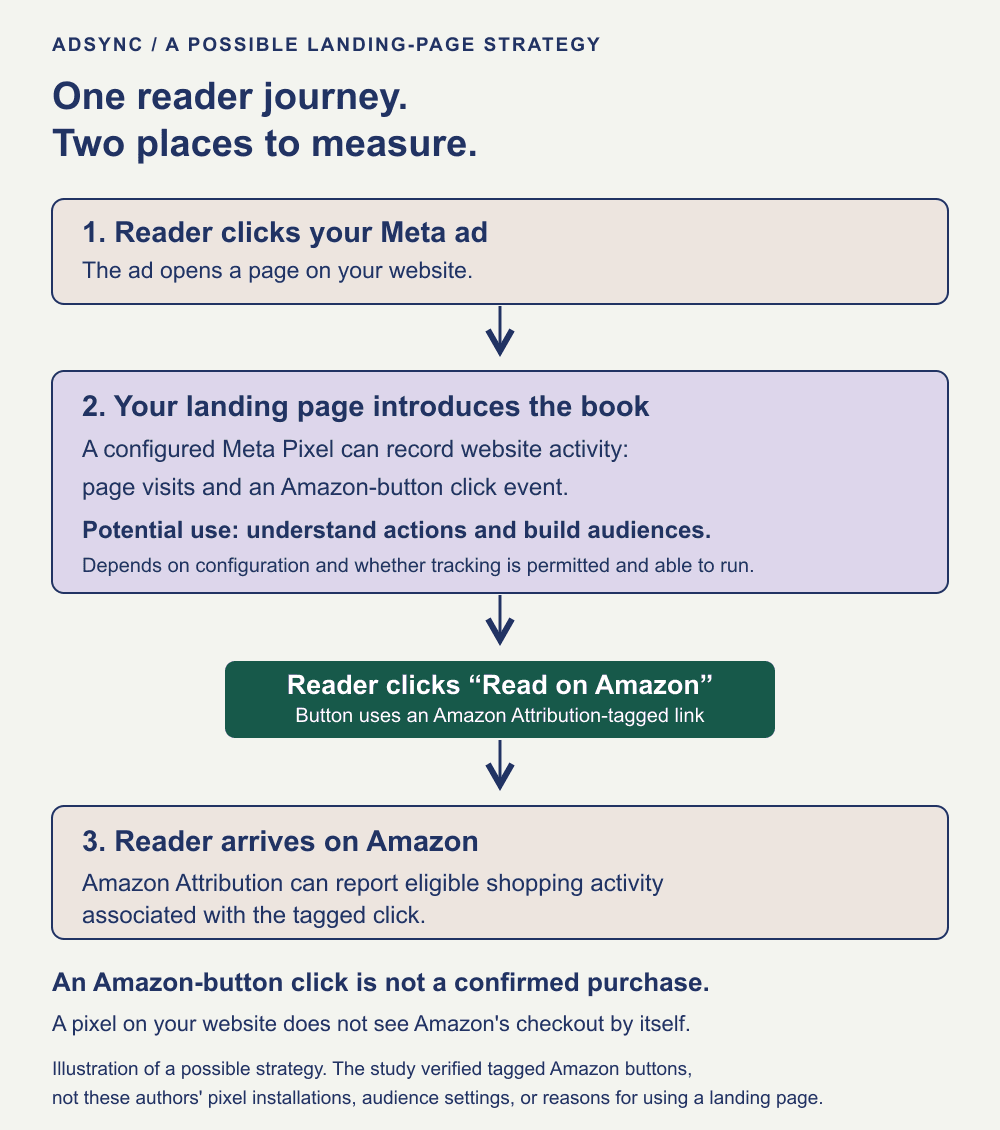
The website visit gives Meta an opportunity to receive a website event, where tracking is permitted and able to run. Clicking the tagged Amazon button then starts the part of the journey Amazon Attribution can measure. That click shows interest in buying; it isn't proof that the reader bought the book. Installing a pixel on your site doesn't make it see the checkout on Amazon.
I've tried this approach myself: send readers to a landing page, collect pixel data there, then send them to Amazon through an Attribution link. I haven't used it in a while, and this makes me want to test it again. That's a test I'd like to run, not a result from this study.
There are other possible reasons for the extra page, too. An author can explain the reading order, introduce a series, offer a sample, or let a reader choose a retailer. It gives you more room to make the case for the book before asking for the sale.
The tradeoff is another page to load and another button to click. Some readers will leave along the way. I'd compare the downstream Amazon results and estimated earnings after ad spend with a direct-to-Amazon campaign before deciding the extra pixel data is worth it. A bigger retargeting audience doesn't pay the bills by itself.
If you're weighing those routes, the guide to using Attribution links covers where the tagged link belongs.
For your own ads, follow the whole journey: ad, landing page if you use one, then the Amazon button. Check the path the reader actually takes (yes, including the button you haven't touched in six months).
The opportunity is making better decisions with the money you're already spending
A missing tag doesn't automatically mean an ad is wasting money. It may be selling books quite happily.
The problem is that, without useful ad-level measurement, you have less evidence for deciding where the next dollar should go. You can leave a losing ad running because its clicks look cheap. You can also leave a winner underfunded because its contribution is hidden inside your overall royalties.
Here's an illustration, not a result from this study. Two ads each spend $50. Using the same royalty assumptions, one produces $90 in estimated attributed royalties and the other produces $10. Together, that's $100 in estimated royalties against $100 in spend. The combined result looks like break-even, while the individual estimates show one ad at $40 above its spend and the other $40 below.
Those are very different decisions hiding inside the same total.
Tracking gives you evidence to investigate that difference. It doesn't guarantee a return, and attributed results still need time to arrive. Retail sales revenue also isn't the same thing as the royalties you keep.
That last distinction is easy to miss. If you're comparing the return with your spend, use the royalty calculation that applies to your book, rather than treating every dollar of retail sales as a dollar you earned.
What you may be leaving on the table is the chance to learn which ads deserve more of your budget. This study didn't measure how much money any advertiser lost or could recover.
Where AdSync fits
This is the problem I built AdSync around. Your spend is in Meta. Your attributed Amazon results are in another report. To work out which ads are paying off, you need to match them.
AdSync brings Meta spend and Amazon Attribution results together at the ad level. For authors, it uses royalty assumptions to help you review estimated earnings after ad spend, keeping attributed sales and estimated royalties distinct.
If you're already using Attribution, the next step is making those results part of your regular ad review. If you're missing tags on the paths you want to measure, start with the setup. A dashboard needs useful tracking data to work with.
You can use the Amazon Attribution setup guide and clickthrough-link checklist to review your links, then compare the spend and results for your existing ads.
What we'd compare next
We found active ads for 13 of 39 Cozy Mystery author brands (33.3%) and 17 of 43 Romantic Suspense author brands (39.5%).
I wouldn't read that as proof that Romantic Suspense authors advertise more. Ten Cozy Mystery matches were unresolved, compared with two in Romantic Suspense. That difference alone makes a neat genre ranking premature.
The next useful expansion would cover broader shelves: science fiction and fantasy, thrillers, and nonfiction, alongside a broader romance list. We'd use the same collection rules, report unresolved matches, and look at how often tagged, untagged, and landing-page paths appear in each category. A second collection date would also help distinguish an ongoing pattern from a launch-week snapshot.
For now, the two-category study gives you a useful prompt for your own account: open the ads you're already paying for, follow their links, and check whether you can connect each ad's spend to the Amazon results you want to measure.
How we collected this snapshot
Date and sample. November 19, 2026. Ranks 1–50 in the Amazon.com Kindle paid Cozy Mystery and Romantic Suspense lists. Four author names appeared in both categories. We deduplicated names case-insensitively, retained pen names as separate brands, and counted author duos as one brand. This is not a count of distinct people or a representative survey of all authors.
Author credits. We systematically sampled the primary displayed author credit. One listing credited fictional author Jessica Fletcher; we used real coauthor Barbara Early, verified against the publisher's listing. The sample includes an estate page and traditionally published authors, so it isn't an indie-only study.
Ad searches. We used Meta Ads Library with All countries, All ads, and Active ads. We checked identifiable author or estate pages, obvious alternate pages, and externally identified handles where available. An ad on an author page may be managed or funded by a publisher or agency. We didn't exhaustively search independent publisher, retailer, or agency pages, and some alternate or Instagram-only advertisers may have been missed.
Link inspection. We inspected destination URLs from the initial loaded ad batches, which ranged from 1 to 30 cards per advertiser, and followed selected shortened links and landing pages. A positive result required at least one visible standard Attribution signal, such as maas=maas_adg... or ref_=aa_maas, on an Amazon-bound path. An affiliate tag alone wasn't counted as Amazon Attribution. Redirects can vary by location or remove visible parameters, so a negative observation doesn't establish non-use. A visible tag also doesn't verify that conversions were recorded correctly.
Limits. Rankings, ads, and links change. We didn't access private advertiser accounts or measure spend, campaign profitability, or sales caused by these ads. Among the 66 resolved author matches, 30 (45.5%) had active ads; the headline uses all 78 sampled brands and reports the 12 unresolved matches separately. The source observations are retained in our research archive; this article presents the aggregate findings and selected public examples.