The Perils of Trusting Meta's Algorithm
My UK ad campaign went from 2x ROAS to barely profitable in two weeks. Meta's algorithm was to blame. Here's what went wrong and how to avoid it.
Two weeks ago, I launched my first ad in the UK market. It was a roaring success.
Side note—that first sentence is actually a big lie, and guilt caught up with me by this sentence, compelling me to explain why I started this article with a lie.
My first time advertising in the UK was actually a couple of months ago, and I spent $50 to get a big fat $0 in royalties. Or so I thought. I didn't know at the time, but when using Amazon Attribution, you have to use the country-specific domain when creating your link. Rookie mistake.
Anyway, back to the exciting news.
The Honeymoon Phase
The ad jumped up to 1.5x ROAS and had a projected 2+ ROAS as soon as day 3. This was tracking to be one of my most successful ads of all time. I was excited that I had discovered a whole new market with seemingly lower CPM than the US market.
The numbers looked fantastic:
- Strong click-through rate
- Decent cost per click
- Sales were rolling in
- ROAS was climbing daily
Everything pointed to a winner. I was already mentally calculating how much I could scale this campaign.
When Things Started to Fall Apart
But two weeks later, I went to evaluate the ad to give myself the confidence to increase the budget. Performance had dropped meaningfully, and now it was just returning 1.3x ROAS (still not too shabby, but a far cry from the 2x I was expecting).
I was able to spot a troubling trend right away. On day 5, even though clicks were up 30%, actual views of the Amazon detail page were down 70%.
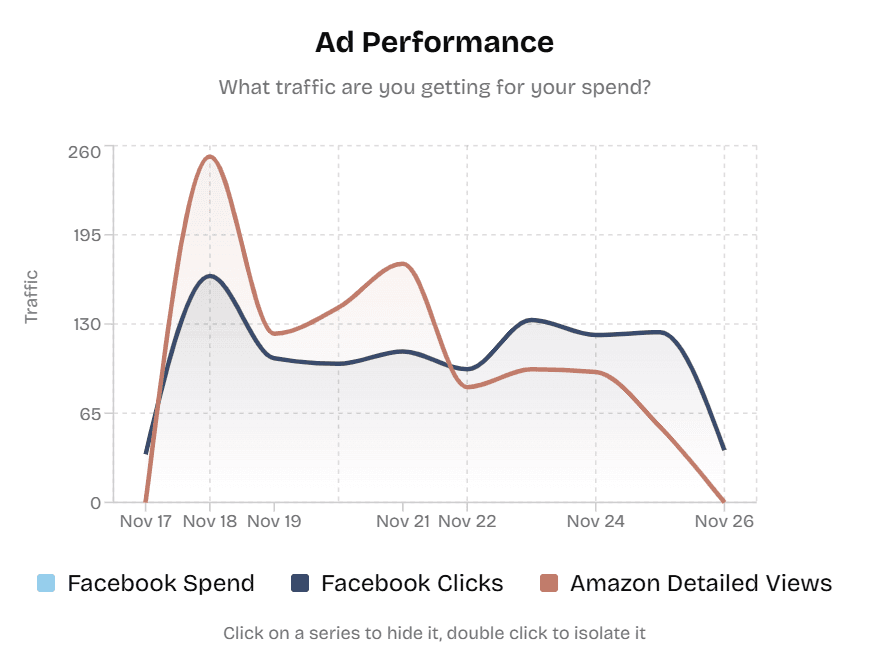
Something changed in Meta's targeting where I was paying more but getting less qualified traffic. People were clicking my ad but bouncing before the Amazon page even fully loaded.
Warning Sign: The Click-to-View Ratio
When your clicks increase but your Amazon detail page views decrease, you're paying for junk traffic. These are people who accidentally click, immediately bounce, or are otherwise completely uninterested in your book. One of my favorite metrics is Cost per Detail Page View (CPDV), which is a more effective way to measure the cost per qualified click.
The Root Problem: No Conversion Feedback
This is always one of the biggest problems KDP authors face when running ads to Amazon.
Meta ads work best when they get conversion feedback. This is what the Meta Pixel is for. Marketing teams install pixel tracking on their website, which in turn tells Meta the results of the visitor to the website (like if a sale was made). Meta then knows if that "profile" of person is someone they should show your ad to again.
But KDP authors can't install a pixel since they're selling on Amazon.com.
So in Meta, you have to choose a "traffic" campaign, and Meta optimizes for the cheapest cost per click—driving the most traffic for your buck—but they don't care (nor do they have visibility into) how qualified that traffic is.
For my ad, something changed in their targeting that drove a lot of unqualified clicks. They thought they were sending a lot of traffic, but those people weren't even waiting for a full page load on Amazon.
Ouch.
Uncovering the Culprit
So what changed?
I dug into the ad breakdown by variant, and it turns out Meta was showing my ad with no text in the ad body.
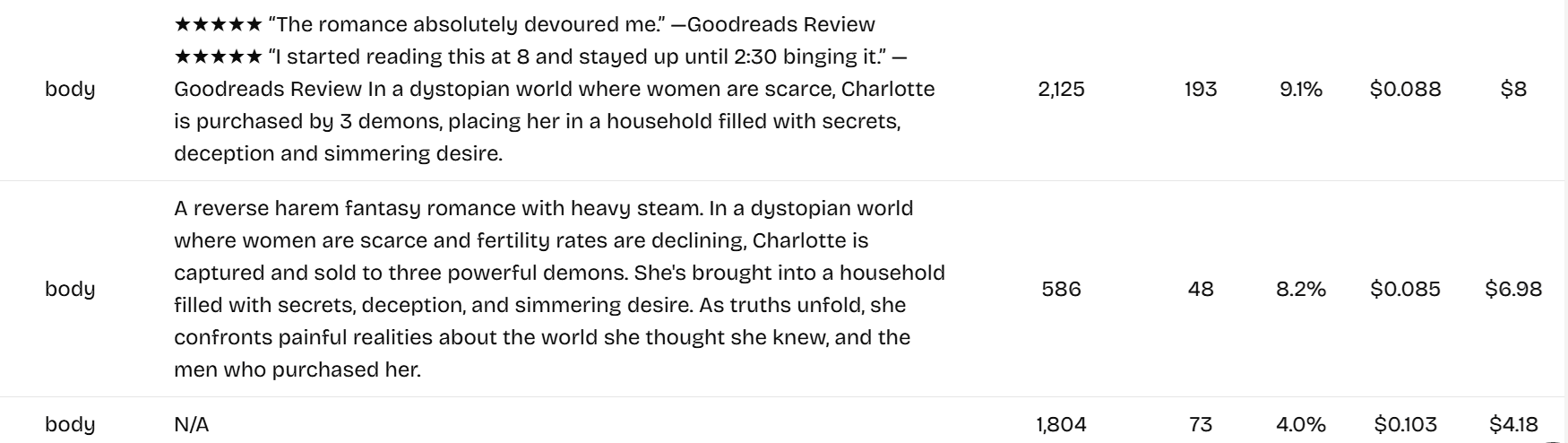
I had set 3 text variations for this ad, and yet Meta was, for a huge chunk of my impressions, just showing... nothing.
The conversion rate on this "N/A" variant was 4%—50% lower than the other 3 variations.
BUT, the CPM on the traffic they were showing the N/A variation to was just $4. So even with a low CTR (click-through rate), the CPC was average, just 25% higher than the other variations.
The Low CPM Red Flag
Low CPM is a huge red flag for traffic campaigns. Low CPM means nobody else is bidding for that traffic. No other advertisers want them, and Meta has labeled them as poor quality.
Think about it: if the average CPM for romance book ads is $10-15, and you're suddenly getting $4 CPM, Meta isn't giving you a gift. They're offloading their bargain-bin traffic onto you.
CPM Context Matters
In my AdSync platform, the killswitch feature actually will automatically turn off an ad with low CPM because this has burned me before. I had a rule to turn off any ad below $4. But that's for the whole ad, not individual variants, and this ad was technically at $4.18 anyway—just barely passing my threshold.
Meta's Algorithm Working Against Me
Here's where it gets really frustrating.
I've always recommended using as many variations as possible in your ads. Meta invests tens of billions of dollars each year to build data centers that can perform advanced calculations to help their algorithms detect winning variants and show those ads to users instead of the lower-performing alternatives.
Except, that's not what happened here.
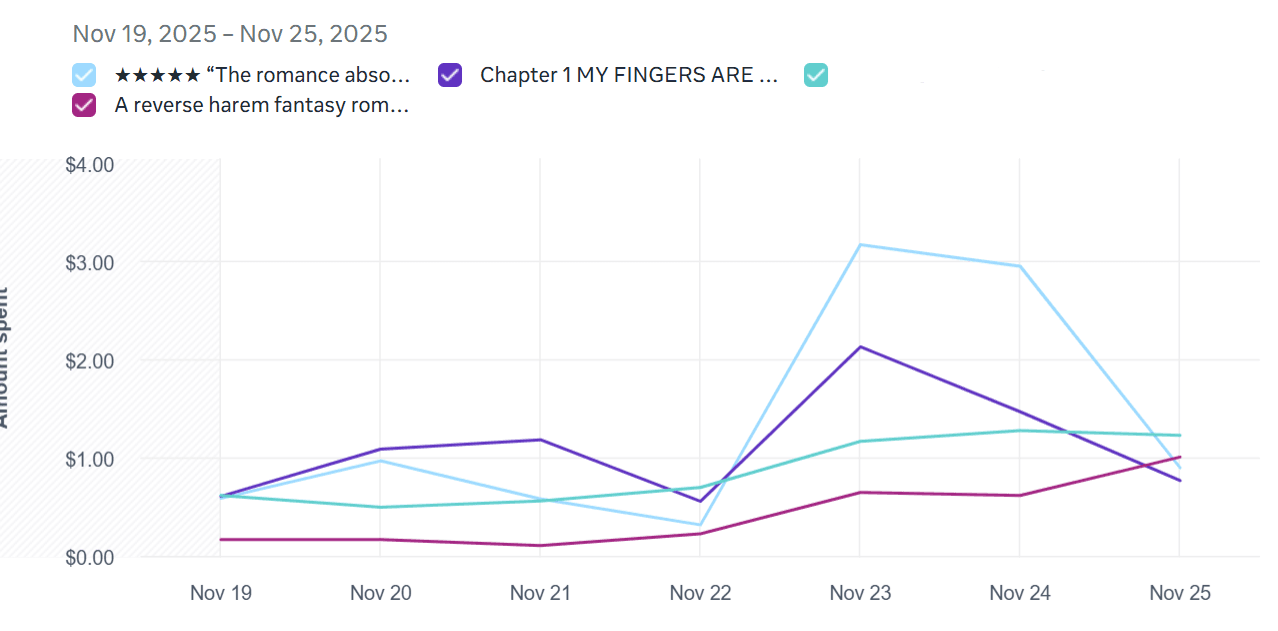
Over the last week, Meta had been spending more and more budget every day on this worst-performing variant, so that by yesterday, it was the body text that got the most impressions and spend.
Why would their algorithm do this? Because from Meta's perspective, they were succeeding:
- They were delivering clicks
- The CPC was reasonable
- They were spending my budget efficiently
But from my perspective as an advertiser? I was paying for worthless traffic that would never convert into book sales.
The Trust But Verify Approach
I can't recommend "Trust but Verify" with Meta ads enough. They have complex tools, but they will not be perfect. They are certainly not built with authors in mind, but rather e-commerce companies spending $100k+ a month in a manner completely different from how an author wants to spend ad money.
Here are the key lessons I learned from this experience:
Your Action Plan
-
Track the quality of the traffic showing up on your Amazon page
Don't just look at clicks. Monitor how many clicks turn into detail page views. -
Check changes over time
Never rest on your laurels, assuming the platform will optimize with your best interests in mind. -
Monitor variant performance
Look at the breakdown by ad creative, body text, and headlines. Meta might be pushing budget toward the wrong variant. -
Watch for low CPM red flags
Suspiciously low CPMs often indicate low-quality traffic. -
Make manual optimizations
Even if an ad starts to perform worse, there are probably always manual optimizations you can make to right-size performance, even if Meta didn't catch those issues themselves.
What I Did to Fix It
Once I identified the problem, the solution was straightforward:
- Turned off the N/A body text variant by explicitly removing the option for Meta to show ads without body text
- Reset the ad learning phase by making these adjustments, forcing Meta to re-optimize
Within three days, my ROAS climbed back to 1.8x, and detail page view rates normalized.
The fix was simple. The hard part was catching the problem in the first place.
Key Metrics to Monitor
To avoid getting burned like I did, keep a close eye on these metrics:
1. Click-to-Detail Page View Ratio
If your Facebook clicks are up but your Amazon detail page views aren't following, you're buying junk traffic.
2. CPM Trends
A sudden drop in CPM is often a warning sign, not a gift.
3. Variant Performance Breakdown
Check which ad variants Meta is actually spending your money on. It might not be the best ones.
4. Cost Per Detail Page View
This is arguably more important than CPC for Amazon advertisers. You want people actually landing on your Amazon page.
AdSync Makes This Easy
In the AdSync dashboard, all of these metrics are tracked automatically. You can see at a glance if your click-to-view ratio drops, if variants are underperforming, or if CPMs hit suspicious levels. The killswitch feature can even automatically pause ads that trigger warning signs.
The Bigger Picture: Why This Happens
Meta's algorithm isn't broken—it's just optimizing for the wrong thing from your perspective.
When you run a traffic campaign (which is what most KDP authors do), Meta's job is to get you clicks as cheaply as possible. They're doing exactly what you asked them to do.
The problem is that not all clicks are created equal. A click from someone who's genuinely interested in your book is worth 10x more than a click from someone who fat-fingered their screen while scrolling.
Without pixel data telling Meta which clicks led to sales, they have no way to distinguish between these two types of traffic.
This is why larger e-commerce companies have such a huge advantage: they can use conversion campaigns that optimize for actual sales, not just clicks.
As a KDP author, you have to be your own quality control.
Optimistic Conclusion
Despite this frustrating experience, I'm actually optimistic about advertising on Meta.
Why? Because once I understood what was happening and made the necessary adjustments, the ad performed beautifully.
The tools are powerful. The reach is incredible. The targeting capabilities are unmatched.
But you have to stay vigilant.
Meta's algorithm will not babysit your campaigns. It will optimize for whatever goal you set, even if that goal doesn't align perfectly with your actual business objective.
The good news? Most of your competitors aren't monitoring these details either. By staying on top of your metrics and making manual optimizations, you can gain a significant edge.
Trust the algorithm, but verify its work. Your ROAS will thank you.